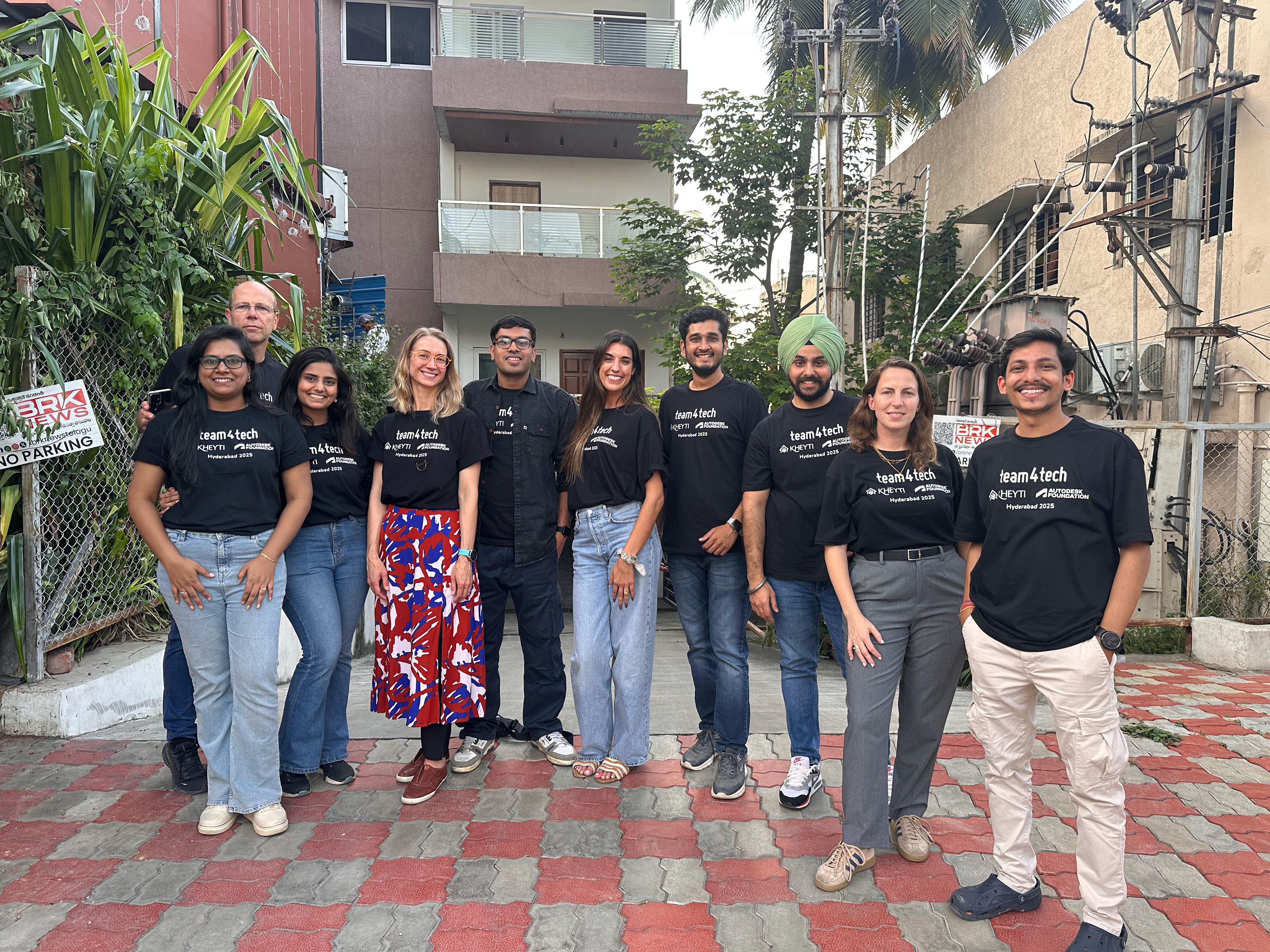
I volunteered on a three‑month Autodesk pro bono engagement with nonprofit Kheyti to explore how technology can help scale their mission. Kheyti works with smallholder farmers across India, providing affordable, climate‑resilient greenhouse solutions, with an ambitious goal of scaling farmer services by 100x while preserving quality and trust.
The Autodesk team included nine contributors across two parallel efforts, one focused on exploratory AI concepts and the other on data foundations. I worked on the data team, leading the user research, synthesis, and farmer journey mapping, to ensure my team's technical recommendations were grounded in real workflows and human needs.
My team's work helped Kheyti step back, understand the system as a whole, and define a more intentional technology roadmap to support their future growth.
Context and problem to solve
Kheyti supports thousands of farmers across multiple regions. Field staff manage onboarding, training, greenhouse installation, crop cycles, and ongoing support. This work relies on a mix of spreadsheets, CRM tools, manual processes, and knowledge held by individuals rather than systems.
Over time, data became fragmented across tools and teams. Manual workarounds multiplied, limiting visibility into farmer progress, increasing strain on field staff, and making it difficult for leadership to rely on data for day-to-day and strategic decisions.
To address this, we framed the work around a central question: How might Kheyti build a reliable data and technology foundation that supports farmer impact while easing operational strain as the organization scales? Our focus was on understanding how current workflows, systems, and data architecture supported the farmer lifecycle, where scalability risks and day-to-day friction were emerging, and what a future-state roadmap aligned with Kheyti’s mission could look like.
Process
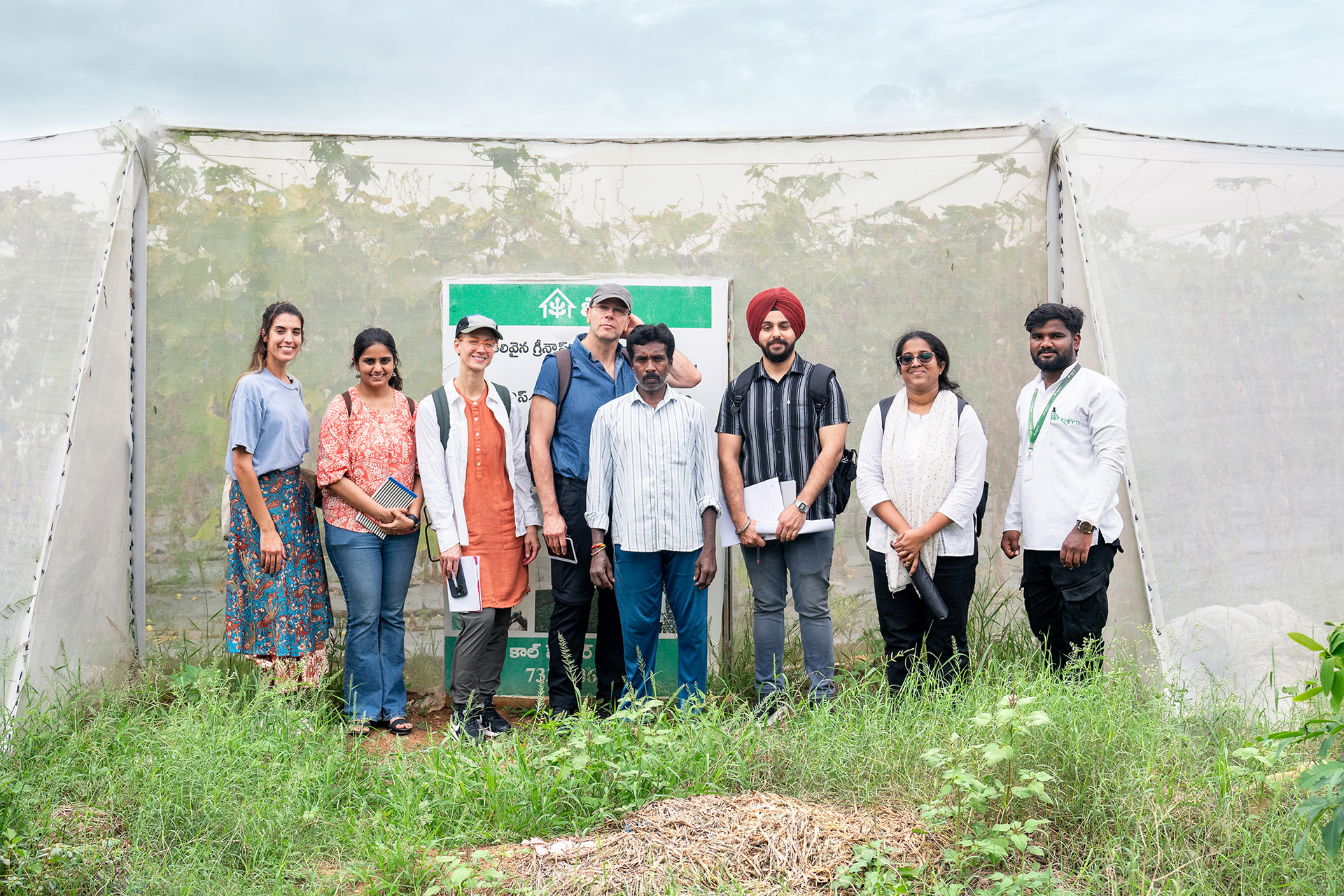
This engagement was grounded in human-centered research and systems thinking, with an emphasis on understanding real workflows before making any recommendations. Over a two-week on-site immersion in India, our team worked closely with Kheyti staff and farmers to learn directly from their lived experiences and operating context. This fieldwork helped uncover workarounds, constraints, and dependencies that were not visible in documentation or dashboards.
We also conducted interviews, workshops, and observations across key internal roles, including field staff, regional managers, operations leaders, and data partners. I led synthesis and journey mapping to connect these inputs into end-to-end views of the farmer lifecycle, translating research insights into clear problem statements and actionable guidance for Kheyti’s future technology roadmap.
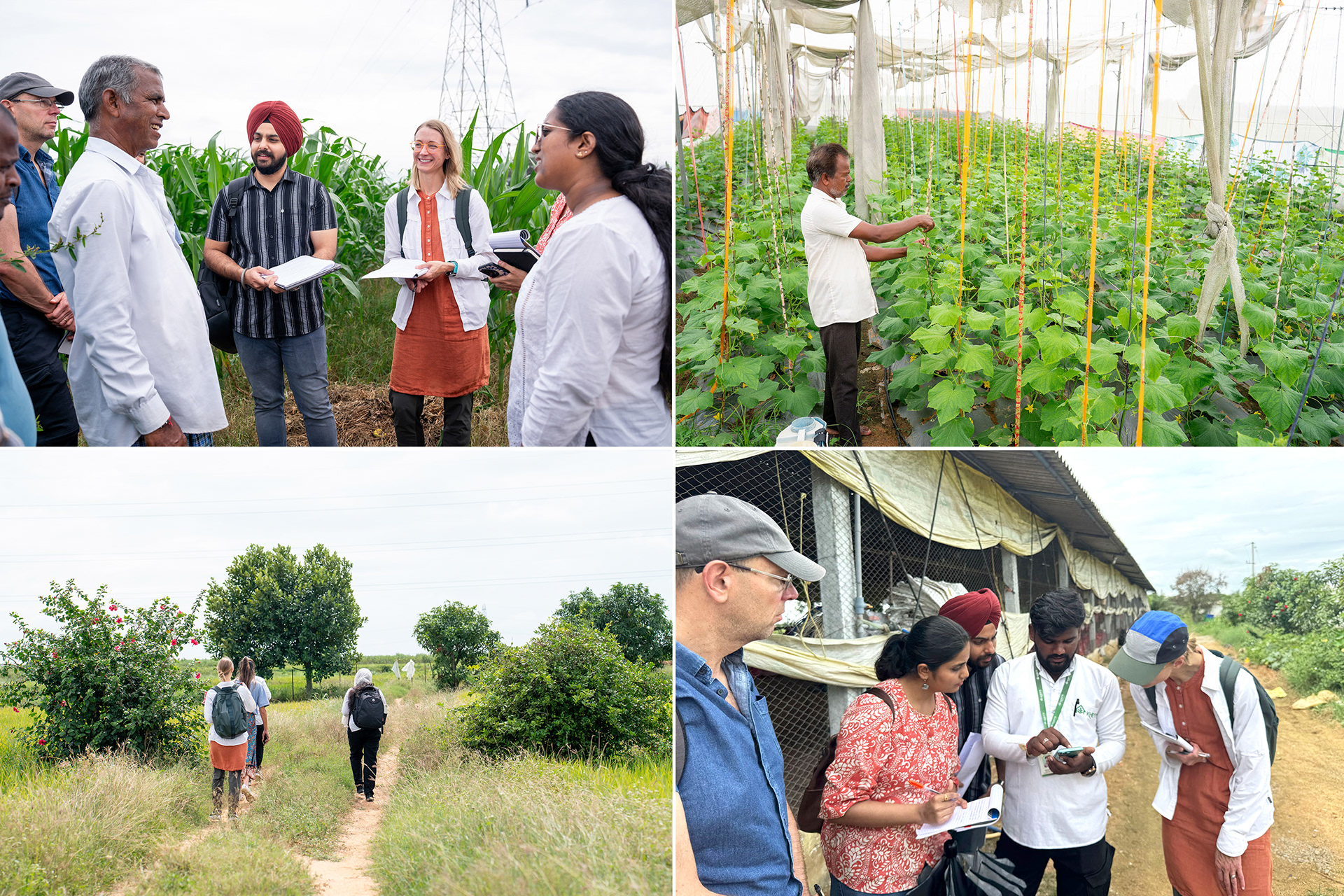
Visiting farmers in Telangana, India to learn about their work.
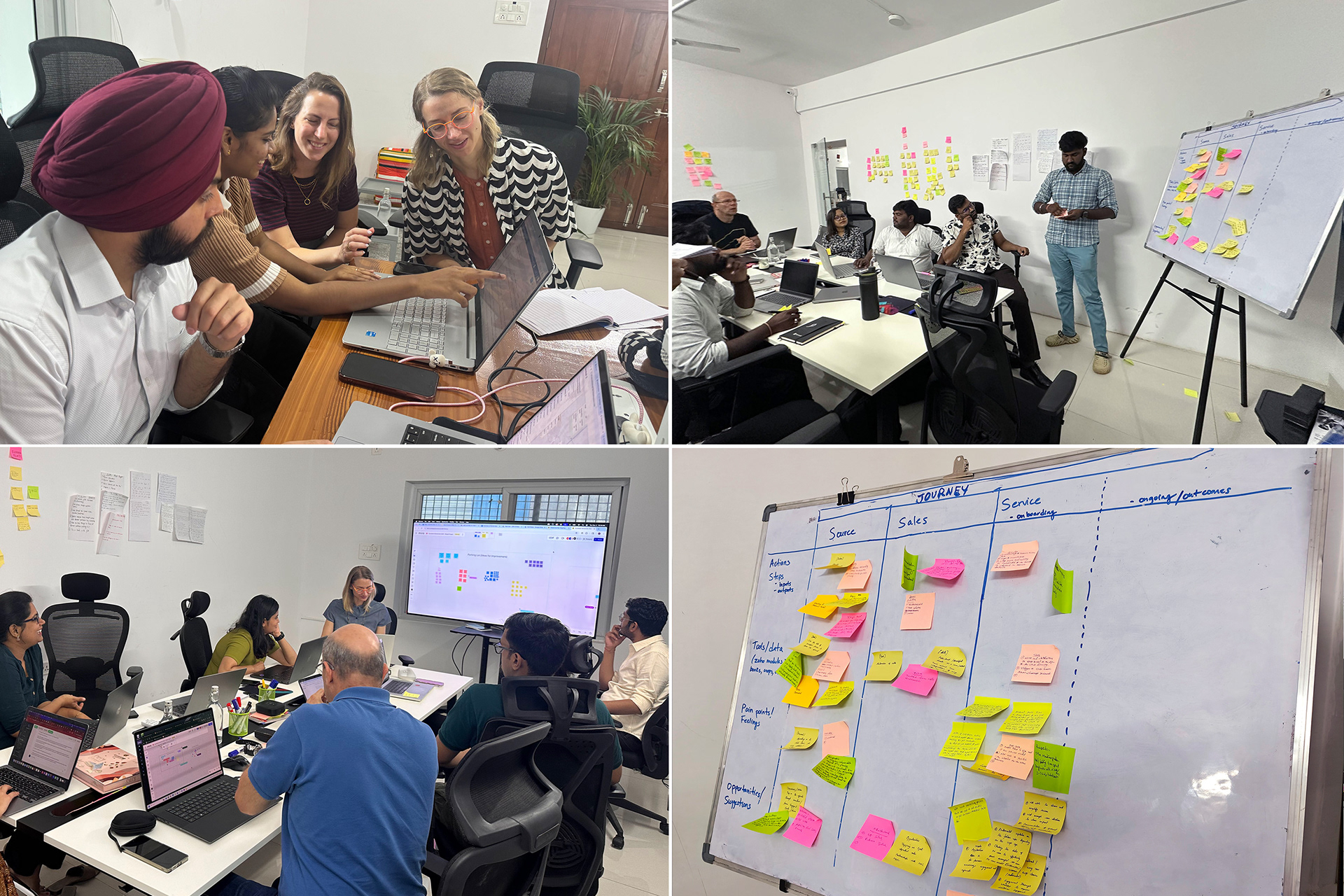
Talking with Kheyti field services, customer support, and other roles to learn about their daily workflows, data touch points, and any pain points.
Journey mapping
Journey mapping was a central contribution of my role on this project. I mapped key workflows across the farmer lifecycle, from onboarding through post-harvest support, to make work visible and align stakeholders around a shared understanding of the system.
These maps covered key roles across the system, including Sales, Field Service Associates (FSAs), Support, Operations, and Farmers. They surfaced:
• Clear pain points, handoffs, and manual workarounds between roles and teams
• Repeated duplication of effort across tools and regions
• Points where data was delayed, lost, or re-entered
• Constraints related to field conditions, mobile use, and offline access
By visualizing the full system end to end, journey maps helped shift conversations away from isolated fixes toward structural change. They became a shared reference point for identifying scalability risks and for grounding technical decisions in the realities of field, mobile, and offline work.
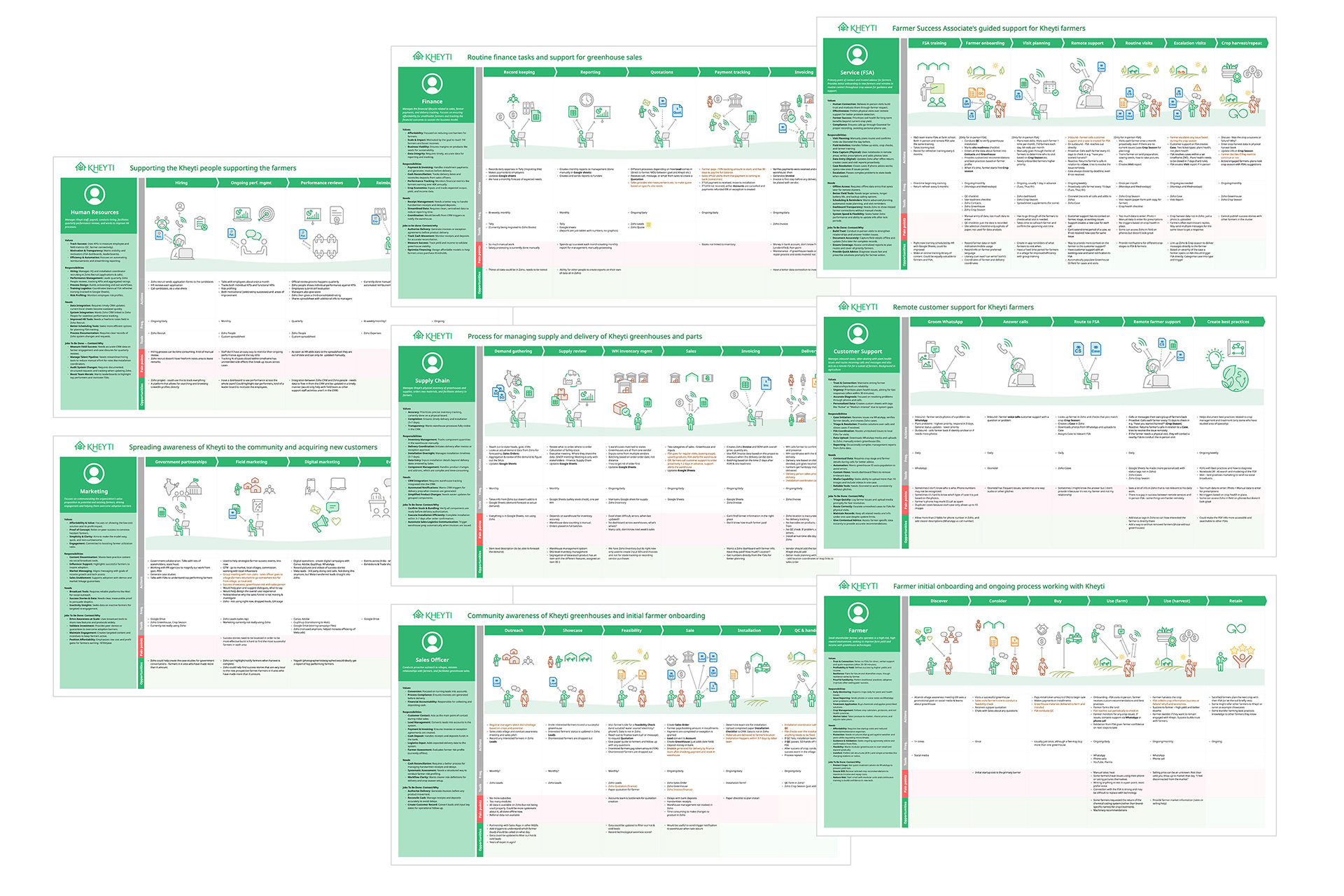
Resulting user journey maps and personas for 8 different Kheyti staff roles.
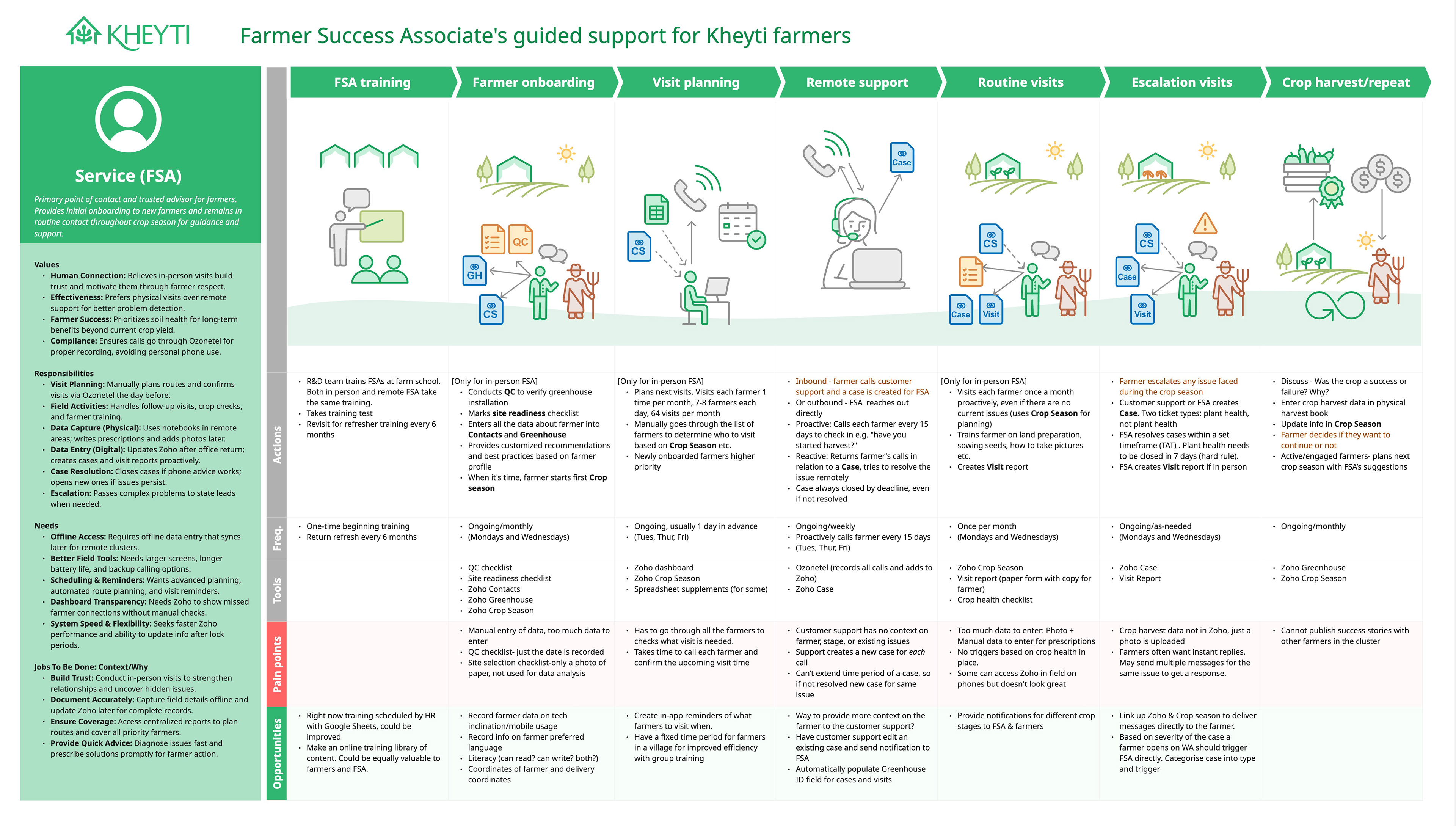
FSA journey map with detailed workflows including when and how the data system is accessed and updated.
Key insights
Patterns that emerged through journey mapping and qualitative research revealed several foundational insights:
• Human relationships are central to Kheyti’s model. Technology needs to reinforce the trust built between field staff and farmers, not attempt to replace it.
• Fragmented systems and manual processes place real limits on scalability, increasing rework and operational strain as farmer volume grows.
• Early, consistent data capture reduces friction downstream, improving coordination, visibility, and decision-making across teams.
• Strong data foundations and clear governance are prerequisites for sustainable growth, not something that can be layered on later.
Together, these insights reframed the challenge from selecting new tools to designing systems that respect human workflows while enabling scale.
Recommendations
Rather than prescribing a single solution, our recommendations focused on strengthening the foundations Kheyti would need to scale sustainably. The emphasis was on reducing structural risk, improving day-to-day usability for staff, and enabling better decision-making over time. At a high level, we recommended:
• Cleaning up and simplifying existing data structures to resolve circular dependencies, improve data quality, and create a more reliable source of truth.
• Strengthening case and incident management to preserve farmer history, reduce duplication, and improve service continuity.
• Introducing lightweight documentation, change management, and governance practices to reduce breakage as systems evolve.
• Investing in additional technical and data-focused roles to support ongoing system health and future growth.
Together, these recommendations formed a phased roadmap, balancing near-term improvements with longer-term structural changes aligned to Kheyti’s mission and growth goals.
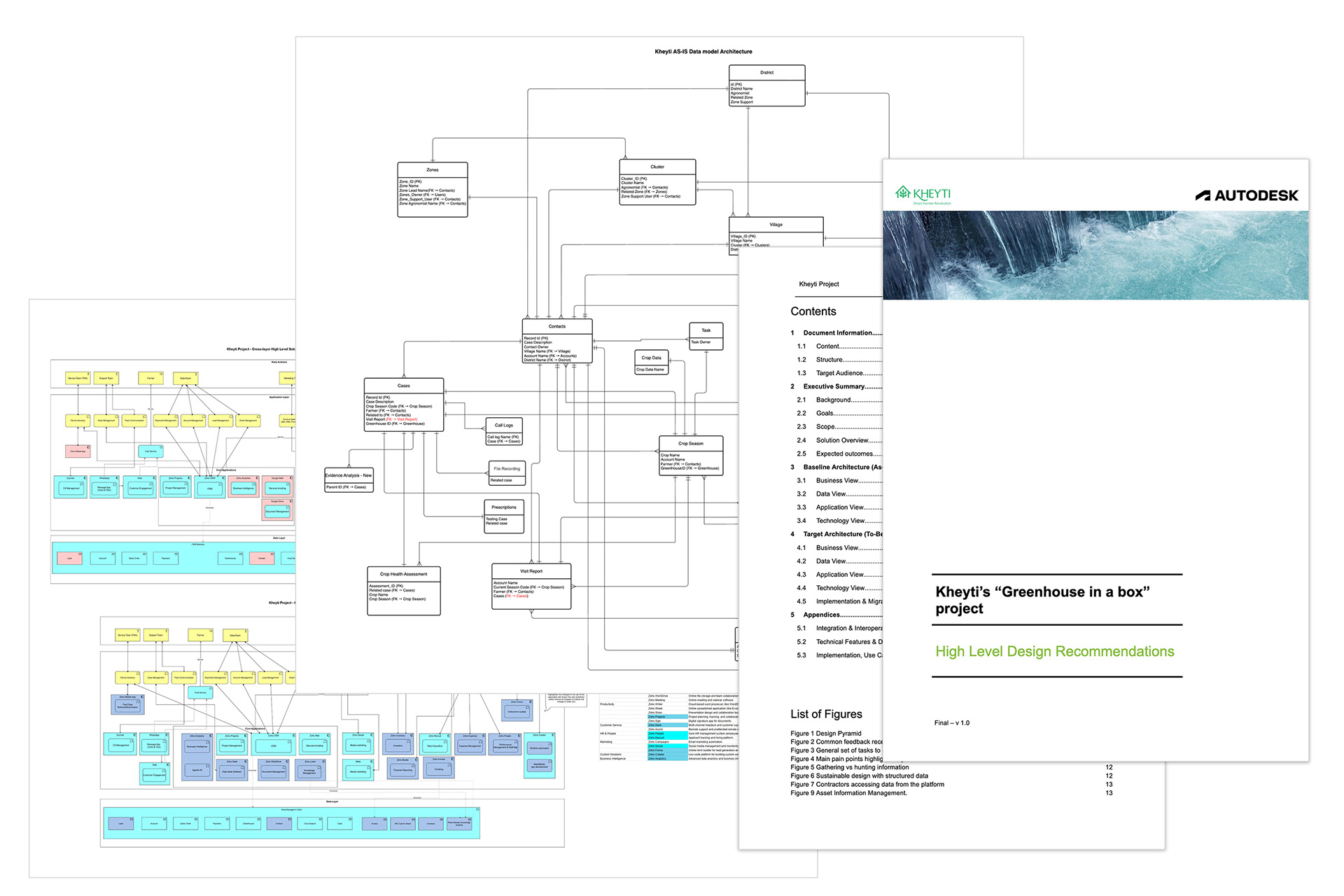
Data architecture and data model diagram work from the team, as well as our final comprehensive recommendations document.
Outcomes
While this engagement did not include direct product implementation, it played a critical role in supporting Kheyti’s growth plans by creating clarity and momentum, aligning teams around a shared understanding of existing systems, reducing uncertainty for leadership, and providing practical guidance for future data and technology investments.
Kheyti has already begun implementing several recommendations. Feedback from Kheyti leadership reinforced the value of this work:
“This group was the most committed group of pro bono volunteers I’ve ever seen. Big thank you to all the volunteers for giving your time.”
“All the efforts and outcomes are very helpful and useful. We are planning to implement your suggestions in the coming months.”
In total I contributed ~200 hours of volunteer time. Through Autodesk’s volunteer match program, I was able to log these hours and donate roughly $2,000 in donations to India-based sustainability nonprofits, creating a meaningful double-impact engagement.
Reflection
This project was an incredibly meaningful opportunity to apply design toward real-world impact. It reinforced that product design is not limited to interfaces or features. In complex, mission-driven environments, research and systems thinking can be the work.
Through this engagement, I deepened my human-centered research practice, built lasting relationships with inspiring teammates and partners, and reaffirmed my belief that thoughtful design and technology truly matter. By grounding decisions in lived experience and operational realities, design can reduce risk, align teams, and enable sustainable impact long before anything is built.